

Ned Biggs is the founder of Suffolk Sea Salt, a new artisan product which is made using traditional and sustainable methods. Here, the salt farmer shares his story
Who are you and what do you do?
My name’s Ned and I’m a salt farmer in Suffolk who uses a traditional and sustainable method to make artisan sea salt.
What has led you to starting up Suffolk Sea Salt?
In early 2020, I stumbled onto a YouTube video about salt making that immediately piqued my interest. In the video, a salt maker was evaporating brine using industrial heat lamps, and I thought it looked like a fun project, so I bought a couple of infrared poultry lamps off a local farmer and started experimenting in my shed. I had them running over some trays of seawater for a while before getting an electricity bill – which is when I realised this was not going to be an economical way of making sea salt!
I did some further research into more economical and sustainable methods and discovered you can make sea salt through solar evaporation using a polytunnel. So then it was a case of finding some land for a polytunnel. I contacted a few local farmers close to the water and asked if I could erect a polytunnel on their land for the purpose of making sea salt. After various setbacks and a couple of false starts, I finally found Poppies Farm. Until recently, it was used as an adult day care centre where they grew vegetables, fruit, flowers and produced eggs and honey, but with the owners, Liz Marley and Lee Smith having recently retired, they very generously agreed to let me use one of their polytunnels to make sea salt.
What is your background? What else do you do?
I spent 20+ years as a DJ and toured extensively around the UK, Europe and Australia as part of a UK hiphop group called The Four Owls. I suppose ‘professionally’ I’m a writer and editor, having worked as a marketing copywriter for the last 12 years. I currently work on the editorial team for a leading commercial fishing publication.
Are you Suffolk born and raised? What do you love about the county?
No, I’m not – I’m actually South London born and raised! In 2013, I met someone from Ipswich (a place I knew very little about at the time) and after a while we decided to move out of London and head to Suffolk. Even though my family and most of my friends are still there, I would never move back to London – I’m a Suffolk boy now!
I love that everything moves a bit slower here and there is just so much space; there’s unlimited beautiful countryside to explore and a gorgeous coastline. One of my favourite things about Suffolk is the strong community vibe and the local pride everyone has, whether it’s a Suffolk cheese, a Suffolk beer or a Suffolk-born popstar – everyone supports local and it’s so great to see.
Has it been a long time in the making? What has the whole process taught you?
I had the idea to make sea salt over six years ago, and in that time countless other bonkers business ideas or projects have fallen by the wayside, but Suffolk Sea Salt stuck with me because I knew it was such a good idea.
At the beginning of the year, I found myself with one day a week free – and I’d been planning the salt thing and experimenting with it for so long, I just thought it’s now or never.
The one thing making sea salt through solar evaporation has taught me is to slow down. I’m quite an excitable person and often find myself doing a million things at once at 100mph, but there is nothing quick about making sea salt the traditional way!
Harvesting the seawater takes ages; filtering and pouring the seawater takes ages; evaporating the seawater takes ages; collecting the salt takes ages; drying the salt takes ages; weighing and jarring the salt takes ages; putting all the labels on takes ages… even navigating the track down to the farm takes ages. And I’ve been trying to do all of this with just one day a week, so, obviously, it’s taking ages!
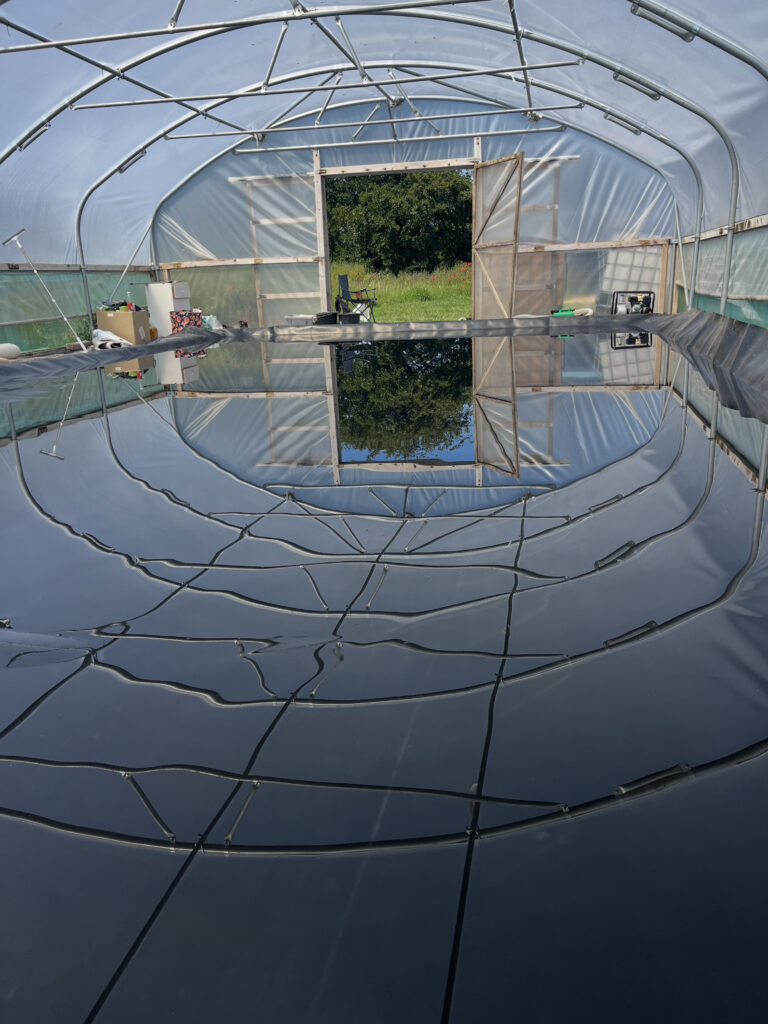
Where do you harvest the saltwater, and where is the polytunnel located?
I harvest the seawater at Felixstowe Ferry on a rising tide. It’s pumped into a tank on a trailer and then taken back to the farm where it’s left to settle for 24 hours. It then passes through a 1-micron filter as it’s poured into one of the two salt pools in the polytunnel. The farm is super-remote, in a really beautiful spot, just north of Trinity Park.
What makes Suffolk Sea Salt special, in your opinion?
Suffolk Sea Salt is different from other sea salts because it’s made 100% naturally using nothing but the sun and wind. No electricity, no gas and no fossil fuels are used during the salt-making process. There’s only a very small handful of artisan salt makers in the UK producing sea salt using this traditional method, and this is the first time sea salt has been made naturally in Suffolk since 1893.
The ‘big’ salt manufacturers evaporate their brine over a constant gas flame on an industrial scale – but that gas will run out one day, so I’m extremely proud that I’ve created a truly sustainable product.
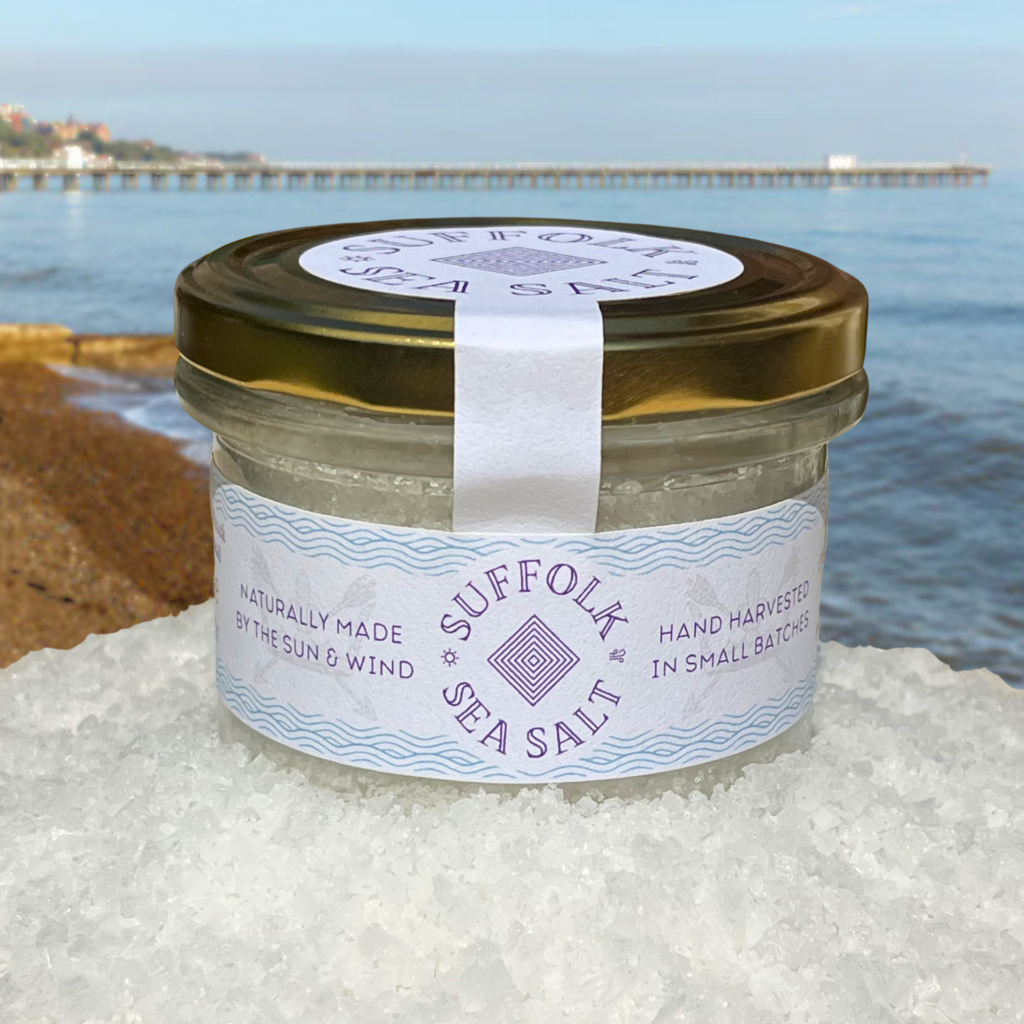
Where can people find the product? Is there a website coming?
The website (www.suffolkseasalt.co.uk) is en route and you’ll be able to order directly from there. But keep your eyes peeled for Suffolk Sea Salt on the shelves of delis, farm shops and general stores around Suffolk very soon. Prospective orders were coming in long before I’d even made any salt, which was pretty bonkers, but very exciting! For now, people can email me at hello@suffolkseasalt.co.uk or find me on Instagram @suffolkseasalt
What are your hopes and dreams for Suffolk Sea Salt?
My goal is to go full-time with Suffolk Sea Salt, hopefully by next summer. I’ve been sitting at a computer, writing, for most of my career and I’m not sure how much I’ve got left in me! It’s time to actually get out there and create something great – and something that the whole of Suffolk can be proud of.
Follow Suffolk Sea Salt (@suffolkseasalt) on Instagram.
Featured image of Ned Biggs – supplied







Leave a Reply