

This month, Artist, Educator and Co-presenter of The Art Channel, Grace Adam appreciates a ‘strange and beautiful planner’ from the 15th Century
Les Très Riches Heures is a Book of Hours, which is essentially a medieval prayer book, with perhaps some modest illustrations for those who could afford to buy one. Church feast days, holy days, prayers to follow and seasonal labours – all designed to keep you on the straight and narrow. Here, everything a devout, medieval human needs to believe, know and do is laid out month by month. You might be able to read some or all of it, but your prayers were probably memorised and the pictures helped! For the very wealthy it could be a lavishly illuminated status symbol as well as political propaganda. During the 14th and 15th centuries they were best sellers.
Les Très Riches Heures is the most lavish and famous example made for a wealthy patron. Paul, Jean, and Herman de Limbourg, highly skilled miniature painters hailed from what is now the Netherlands. Together they created some of the most beautiful, illuminated books. Roughly A4 size and painted on over 200 leaves of vellum (fine calfskin), this amazing creation knocked around various private collections virtually forgotten for three centuries, resurfacing in 1856.
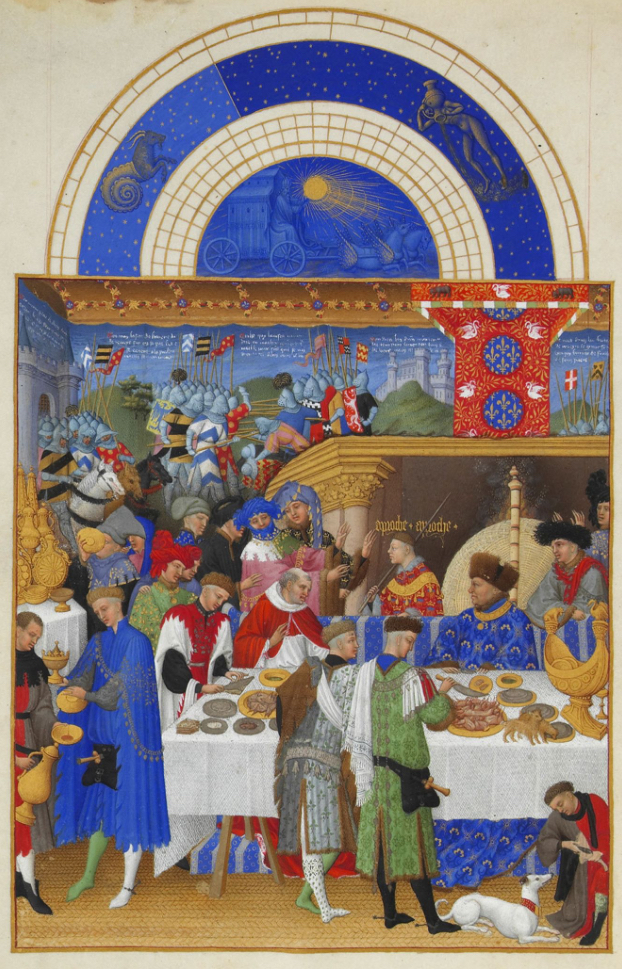
At the top of every calendar page sit the corresponding Zodiac signs. January has the Sun God Apollo in his winged chariot beginning his ascent into the new year, along with Capricorn and Aquarius. (Incidentally, medieval people believed that illnesses corresponded to the constellation they were born under). Celestial patterns governed the farming year, and the church calendar used the zodiac to calculate feast days.
Each month had its tasks: January, featured here was a month of feasting and gift giving, although you had to cut your coat according to your cloth. For February, Les Très Riches Heures shows peasants warming various parts of themselves in front of a fire. Outside in the snow, wood is chopped, birds peck at grain and sheep shelter beside four beehives and a frozen haystack – all under a harsh grey sky.
So, what’s going on in January? A feast is presided over by the patron of the book. The man sitting on the far side of the table sporting an ornate blue robe with gold decoration is the man who paid for it, Jean de France, Duc de Berry. Swans, fleurs-de-lis plus two bears feature on the banner behind him. Another bear balances on the huge gold salt cellar – heraldry and royal connections. He wasn’t going to miss an opportunity for a bit of political mileage.

The table laden with goodies is dominated by the outsize ship-shaped salt cellar, (an item that features in inventories of the duke’s household possessions). When this manuscript was painted salt was extremely expensive. Imported and taxed heavily, it is the duke who has it strategically placed in front of him. Valued guests would be ‘above the salt’, while less important diners would sit further away from it and the duke. Padding about on the white damask tablecloth two of his indulged lapdogs try their luck. Close by, a sleek white greyhound wearing a red collar is fed by a courtier.
Behind the duke various chilly, but well-dressed figures raise their hands to the fire for warmth. The three men wearing the wild black hats have been identified as the Limbourg brothers – possibly. Other sources maintain that the guy in the floppy grey felt hat is Paul de Limbourg. It would be nice to think they are there amongst the revellers, but we’ll never know. (Talking of hats, the duke has the poshest hat-made from fur).
The action is set against the backdrop of an expensive and wonderful tapestry of a battle scene. The duke was careful to have his 17 chateaux and lands feature in many of the illustrations-projecting prosperity, lineage and hierarchy. The Duke de Berry, the third son of the future King John II of France, wielded immense power and lived the high life. He collected and commissioned art, architecture, books and jewellery so extravagantly that he died owing vast sums of money.
Although the Limbourg brothers are credited with the book’s creation, tragically the three brothers and their patron all died from the plague in 1416 before its completion. Consequently, many artists from the low countries have made contributions to the book over the years.
Putting things in the diary for 2026? I can guarantee your new diary or the graphics on your phone won’t compare to this strange and beautiful planner, but you will have a little more say over what you do each month!
Visit www.graceadam.com and The Art Channel.
Featured image of Grace Adam – supplied






Fascinating, timely and insightful as always!
What beautiful images and a fascinating insight, thank you !
Brava! Great choice.
Really interesting article Grace. Thank you
Thank you : )