
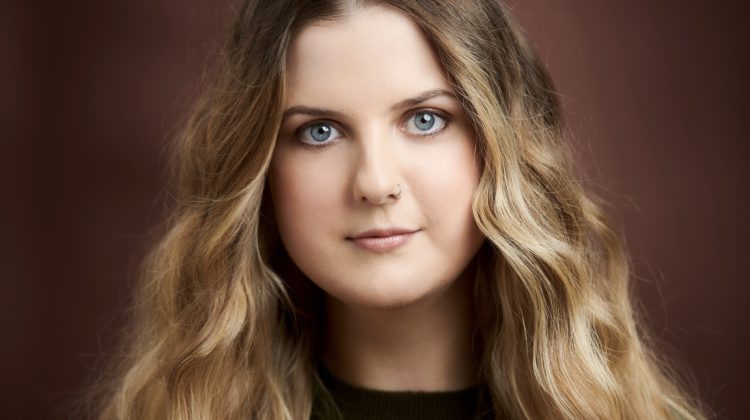
Ella Glendining is a disabled writer and director, whose short film Octopus is premiering at BFI Flare 2022 – the London LGBTQIA+ Film Festival which starts today. Here, she explains that the story about growing up ‘other’ in an archetypal small town is also an honest look at love and heartbreak.
When did you realise that writing and directing was the avenue you wanted to take?
I had creative parents who were always telling stories. I think a huge contributing factor to my wanting to become a filmmaker was the regular trips to the ‘video shop’ my mum would take me on when I was very little. It was the highlight of my life. She introduced me to so many wonderful films. I can’t remember not wanting to be a writer/director, but another influence was my dad’s wildlife filmmaking, which he did throughout my childhood. English, particularly creative writing, was the only academic subject that came naturally to me at school, and I excelled in it. I remember a favourite primary school teacher of mine telling me to ‘never stop writing’, and I really took that to heart.
And it’s clearly very important for you to be championing disability arts?
Similarly, I can’t remember a time that I didn’t want to work towards improving things for disabled people. Even at five years old I remember thinking like this, but of course at that age I didn’t know what form it would take. I see my work as activism. Disabled people are so rarely given a voice in cinema, and I am determined to challenge that. I will never not make work that includes disabled people and will always tell stories from disabled perspectives. Simply creating a multi-layered disabled character is a political statement.
How was everything looking for you at the start of the pandemic?
The pandemic felt like a Zombie apocalypse at first, and for the first year, a lot of my work and plans had to be delayed/put on hold. I am starting to make good traction with various projects now and I am loving throwing myself back into my creative work, but always in the back of my mind I know how lucky I am to be vaccinated and not in the extremely clinically vulnerable category (although I am somewhat clinically vulnerable). Life has to go on, but I don’t believe it should be at the expense of disabled and chronically ill people, which is something I often grapple with. I feel guilty about my privilege in that sense.
You mention that you’re too sensitive to be doing what you’re doing – do you have any strategies for coping?
Ha! I am so sensitive. I haven’t had therapy for a while but am a big advocate for it. I have also recently started on anti-anxiety medication for the first time in my life, which seems to me helping my anxiety a bit, which at times can feel crushingly overwhelming. However, the biggest medicine for my soul is my relationships with loved ones, especially within the disabled and queer communities. Finding ‘my people’ at various points throughout my life has been the most liberating and powerful thing.
Tell us about the shooting of Octopus – particularly the scenes in the sea…
Octopus follows the story of disabled new mum Mini as she returns to her sleepy seaside hometown for the funeral of a friend. It examines the tensions within her previously tight-knit friendship group as she grapples with feeling torn between two worlds. I love the sea scene. I wanted it to be both a comment on how we grieve in this culture and a nod to the closeness and beauty of queer friendship groups, or rather the special kind of love that can develop between people considered outsiders. The sea scene is like a baptism as the friends cling to each other, each one holding the next above the waves. It is very symbolic.
It has a message about grief…as well as a message for anyone who has grown up in a small-town queer and/or disabled?
Yes, it is very much about grief. As morbid as it might sound, it is about how some of us ‘othered’ people can’t make it through the pain of life. The idea with Frank is not that he wasn’t accepted because of his queerness or anything like that. It is more that the world wasn’t built for him as someone with profound mental health issues. This is all subtext that isn’t explicitly stated in the film, but this backstory was very important in the development of the story and the tone of the film. It is not a miserable film though; it is first and foremost a celebration of love in all its forms.
Norwich is your hometown and Octopus was shot in Sheringham – how special is Norfolk to you?
Norfolk is incredibly special to me. Although I live in Brighton now, a huge part of my heart will always be in Norfolk. I grew up in a village called Elsing and spent much of my late teens and early 20s hanging out with my friend Naomi in Sheringham. I am very grateful for Naomi’s part in the telling of this story. It is her story as much as it is mine, and the truth is, I made the film for her. Octopus was produced by Jessi Gutch who is an amazing creative force of nature for whom I will forever be grateful. Having both disabled and queer people at the centre of this production meant everything to me.
How excited are you for Octopus to be premiering at the BFI Flare Festival on March 26?
I am so excited that Octopus will be premiering at BFI Flare Festival! It is a bit of a dream come true. And it’s very validating when I always feel so conflicted about my work.
Where do you go from here?
My first feature film, ‘Is There Anybody Out There?’ is currently in post-production, and the edit should be finished this year, which is so exciting as I have been shooting for over four years! It is a personal documentary about my search for others with the same disability as me and my becoming a mum, but it is really about ableism and being disabled and proud. My heart really lies in writing and working with actors though, and I am in the early stages of developing a fiction feature with producer Janine Marmot (who’s also producing my documentary). It is a historical drama film with a disabled characters at its core, and I could not be more excited about this project…
‘Octopus’, written and directed by Ella Glendining, premieres at BFI Flare: London LGBTQIA+ Film Festival on March 26. Visit Ella Bee Glendining (@ella_bee_g) on Instagram and BFI Network
Featured image of Ella Glendining – picture credit: David Myers


Leave a Reply